Christmas Tree Varieties / Types
Click here for a PDF Print version to take with you to the farm or lot.
(With the PDF above, you can print just everything, just the table or pages of the trees you like!)
Looking for the right tree, but don't know which variety is right for you? This guide will help you decide which Christmas Tree species or types sold and grown in the United States is worth the price and has the properties you want. Click on the links below for more information about each type. You may also like the automatic tree watering device that looks like a Christmas present, or the plain version. The links for photos and more info open new windows, so just close them to return to this page. Be sure to see the page about how to care for your Christmas tree and prevent needle drop to make your tree last longer! Click here for the guide to UK Christmas tree varieties .
| Selection Guide to the Most Common Christmas Tree Varieties (ALL trees are described on their pages, click on the links to Tree types - Firs,
Cedars, etc.) |
||||||||||||
| Firs | Pines | Spruces | Cypress | Cedars | Misc | |||||||
| Unusual and Potted | ||||||||||||
| Needle Holding (without water) |
4 | 5 | 5 | 5 | 5 | 3 | 1 | 4 | 4 | 3 | 3 | varies |
| Needle Holding (with water) |
5 | 5 | 5 | 5 | 5 | 4 | 2 | 5 | 4 | 3 | 3 | varies |
| Firmness Branches | 2 | 3 | 3 | 5 | 2 | 4 | 3 | 5 | 2 | 2 | 2 | varies |
| Fragrance | 5 | 5 | 4 | 3 | 4 | 1 | 3 | 3 | 2 | 2 | 4 | varies |
| Needle softness | 5 | 5 | 5 | 2 | 5 | 3 | 3 | 3 | 5 | 3 | 4 | varies |
| Cost | 2 | 3 | 3 | 5 | 4 | 3 | 2 | 1 | 4 | 3 | 3 | varies |
|
|
||||||||||||
Firs
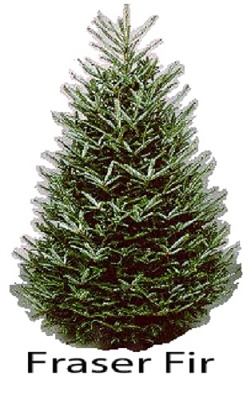
Fir trees are the traditional Christmas tree for most Americans because they have the key qualities: great fragrance, short sturdy needles and branches and good needle retention. If keep watered and not in a hot room, they'll hold their needles up to Christmas.
There are several popular varieties. In the United States, the Fraser Fir is the most popular Christmas tree. However, it only grows in cooler climates, native to eastern North America. It occurs from Newfoundland, Canada west through the Great Lakes region to southeastern Manitoba and Minnesota, United States, and south along the Appalachian Mountains and upper Piedmont to the mountains of Northern Georgia and western north Carolina. Most precut Christmas trees sold in big box stores, like Costco, Walmart, Home Depot are Fraser Firs shipped from the far north or Canada.
Pines
Pines are a good compromise betwe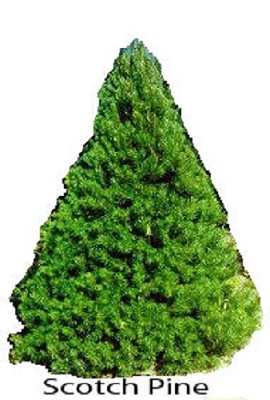 en firs and cypress: they look and
smell more like a traditional Christmas tree, are easily pruned to a
good shape in the field and grow well in the warmer climates. But
they can produce a lot of sap and that is sticky.
Needle retention usually is very good. But the do tend to ooze sticky sap especially from broken limbs and teh fresh cuts, so use a tree skirt or
drop cloth.
en firs and cypress: they look and
smell more like a traditional Christmas tree, are easily pruned to a
good shape in the field and grow well in the warmer climates. But
they can produce a lot of sap and that is sticky.
Needle retention usually is very good. But the do tend to ooze sticky sap especially from broken limbs and teh fresh cuts, so use a tree skirt or
drop cloth.
Pines grow almost anywhere. In hot climates, like the deep South, pines may be the only locally grown choice.
Scotch Pine is most common pine Christmas tree; stiff branches; stiff, dark green needles one inch long; holds needles for four weeks; needles will stay on even when dry; has open appearance and more room for ornaments; keeps aroma throughout the season; introduced into United States by European settlers.
Spruce
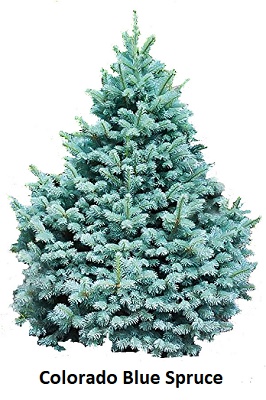
Spruce are generally more like the firs in appearance, with short, stiff needles and branches that hold ornaments well. Blue and White Spruce have a particularly beautiful color.
Cedars
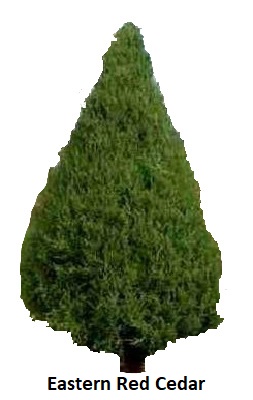
Cedars are only commonly used as Christmas trees in hot climates where the firs will not grow - and people want to cut a tree locally. So you will see them in places like Arizona, Texas and the Deep South.
Cypress
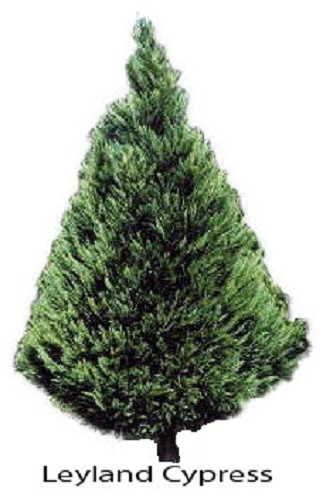
Thanks to growing well in the heat (unlike firs) Cypress are the most commonly growth Christmas tree in the deep South. Their needles are soft to the touch, but the branches aim upwards, rather than straight out, and are not great at holding heave ornaments. Photo at right - foliage is dark green to gray color; has upright branches with a feathery appearance; has a light scent; good for people with allergies to other Christmas tree types. The most popular Christmas tree in the South-East, the Leyland Cypress is dark green - gray in color and has very little aroma. The needles are soft and won't hurt even a toddler. Because it is not in the Pine or Fir family, it does not produce sap, so that those with an allergy to sap can still enjoy a Leyland as their Christmas Tree. If you live in very warm climates, like the Deep South, the Leyland may be your only choice if you want to cut your own tree.
The most common Cypress trees are:
Murray Cypress
Miscellaneous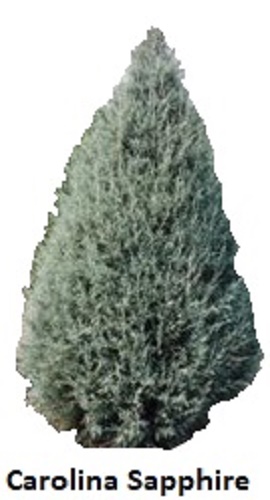
Carolina Sapphire
Cupressus arizonica var. glabra - 'Carolina Sapphire'
Has steely, blue needles; dense, lacy foliage; yellow flowers and nice scent; smells like a cross between lemon and mint. More info .
- Grows well in the deep South so this may be a good choice if you want to cut your own tree at a choose-and-cut tree farm in the Deep South.
 Green Giant Arborvitae
Green Giant arborvitae is a big, fast-growing evergreen that will probably top out at around 60 feet tall but with a basal spread of around 15 to 20 feet. Its fast growth and natural exclamation mark form makes it ideally suited for screening,. It can be pruned to manage its size. It is a hybrid of Thuja standishii (Japanese Arborvitae) and T. plicata (Western Red Cedar). Part of Green Giant' s popularity is because it' s being used to replace Leyland cypress hedges that have begun developing disease problems across the southeast. So, if you get a rooted arborvitae, you can plant it after Christmas!
Potted Christmas trees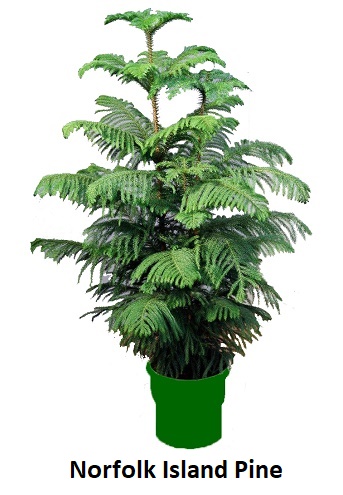
Potted Christmas trees
Norfolk Island Pine
A tree from the tropics, these make a great houseplant AND they look great decorated as a Christmas tree.
- See this page for more information about Norfolk Island Pines.
- And this page has information about tropical trees of Florida .
Australians occasionally use a native plant called Australian Christmas tree, (Nuytsia floribunda, aka moodjar) as a living Christmas tree.
For Easter egg Hunts, Children's Consignment Sales, Local Farm Markets and other types of Farms, click here.
Find Other types of farms:
- Farm markets and roadside stands
- Road trips and camping resources
- Home canning supplies at the best prices on the internet!
- Maple Syrup Farms, sugarworks, maple syrup festivals
- Environmental information and resources
- Consumer fraud and scams information
- Farms For Your Event for birthday parties, weddings, receptions, business meetings, retreats, etc.
- Pick Your Own fruits and vegetable farms
- Festivals - local fruit and vegetable festivals
- Local Honey, apiaries, beekeepers
- Local Meat, Milk and Eggs
Get the
most recent version of
the Ball Blue Book
Find Other types of farms:
- Farm markets and roadside stands
- Road trips and camping resources
- Home canning supplies at the best prices on the internet!
- Maple Syrup Farms, sugarworks, maple syrup festivals
- Environmental information and resources
- Consumer fraud and scams information
- Farms For Your Event for birthday parties, weddings, receptions, business meetings, retreats, etc.
- Pick Your Own fruits and vegetable farms
- Festivals - local fruit and vegetable festivals
- Local Honey, apiaries, beekeepers
- Local Meat, Milk and Eggs
Get the
most recent version of
the Ball Blue Book